All posts by Chad

Thoughts on 2012

Calendar 2012

This morning I sat down to think about 2012. New Years resolutions are a good thing, I think, especially in the context of self-evaluation and planning. It is good to reflect on the activity in our lives. It is good to think about the world around us and how the lives of others have been affected recently. We should probably be in the habit of doing this more often.

I came across a text in the book of Exodus during meditation this morning. When the Lord was instructing Moses in Exodus 25 and the following chapters regarding the construction of the Tabernacle, he promised to provide the skills to accomplish the work (more accurately, skilled labor). Look at this passage from Exodus 31:1-6…

1 Then the LORD said to Moses, 2 “See, I have chosen Bezalel son of Uri, the son of Hur, of the tribe of Judah, 3 and I have filled him with the Spirit of God, with wisdom, with understanding, with knowledge and with all kinds of skills— 4 to make artistic designs for work in gold, silver and bronze, 5 to cut and set stones, to work in wood, and to engage in all kinds of crafts. 6 Moreover, I have appointed Oholiab son of Ahisamak, of the tribe of Dan, to help him

Not only did God give Moses the blueprints for what to make, but he gave skills to those who would do the work. In particular, there were two men, Bezalel and Oholiab. Bezalel’s gifts BEGAN with wisdom and understanding. It wasn’t just a skill set that the Lord gave to him. First and foremost, he granted wisdom and understanding, which are key ingredients in a person’s life if they are to best use the skills God has given them.

The wisdom and understanding to use our gifts and talents are incredibly important. There is another key in what God provided, though, and that is HELP. I don’t think we’re meant to travel this world in isolation. Oholiab was appointed to help Bezalel, so as together they would bear the burden, manage other workers, cast vision for the people, etc. In my life, those closest to me will be heavily involved if I am to meet my 2012 goals. My commitments cannot be made in a vacuum with only myself to consider! Nor am I alone in trying to meet my goals!

So, for 2012 I have set a supreme goal to live my life in greater wisdom and understanding:

Wisdom is supreme; therefore get wisdom. Though it cost all you have, get understanding. (Prov. 4:7)

Beneath this unifying goal I have set 4 areas of life in which to improve/change. I want to:

1. Have a focused approach to writing, with set goals
2. Intentionally schedule music creation sessions
3. Establish more regular reading habits
4. Accomplish disciplined professional development.

All of these things must be done under the banner of wisdom, not knowledge alone. I am currently contemplating the sacrifices that will be necessary for me to succeed in these four areas. I’ll make an attempt throughout the year to write about these focus areas in my life and share my experience in trying to do them with wisdom and understanding as my shelter.

Do you have goals and/or resolutions for the new year? How do you come to set your goals? Would love to hear your thoughts on the subject. – Chad
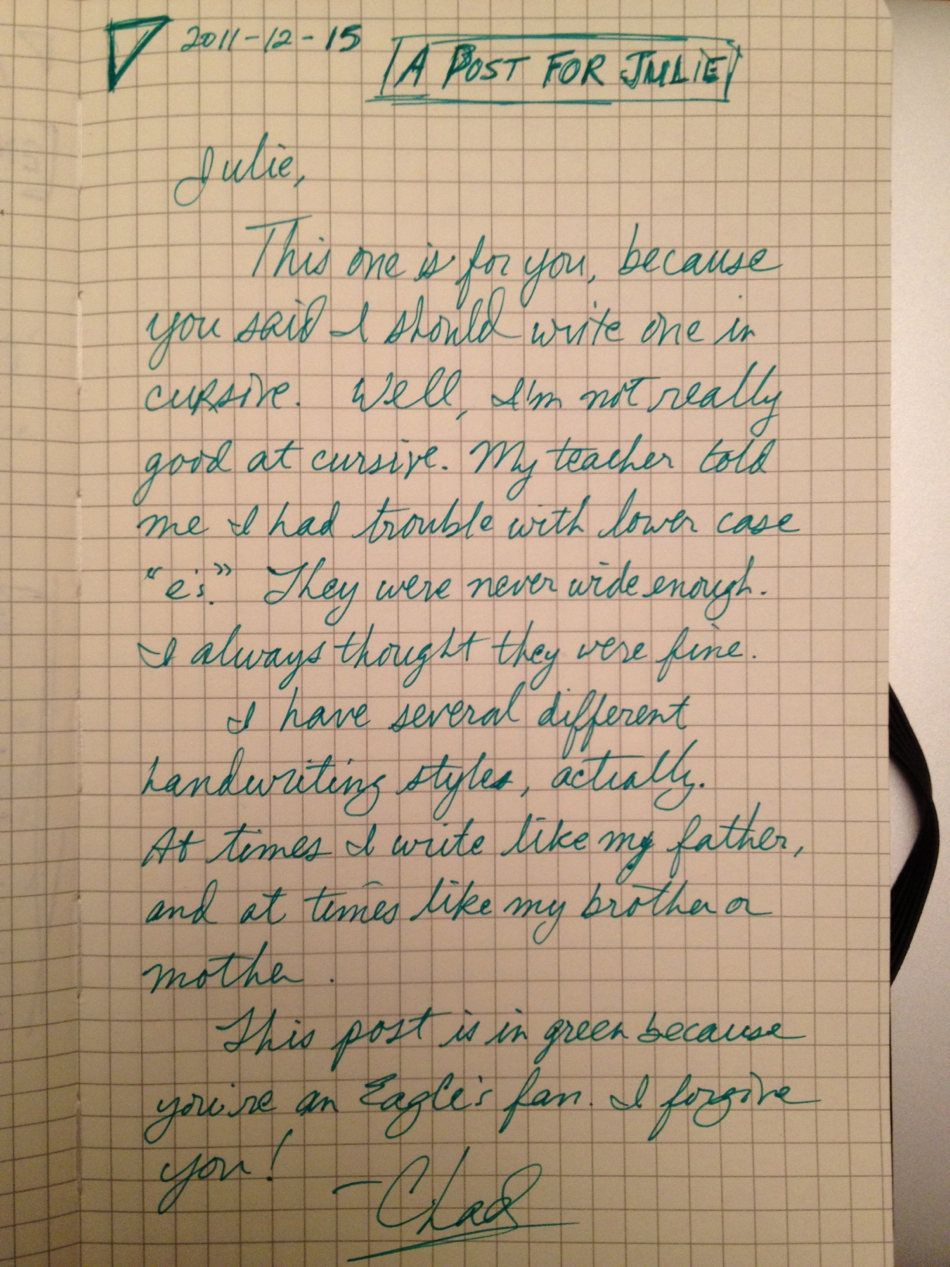
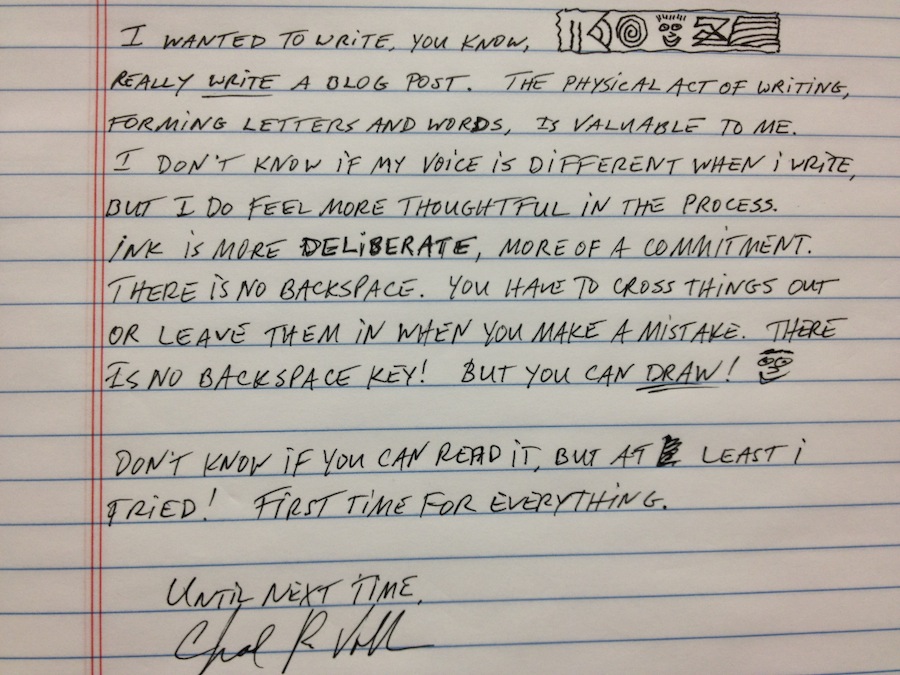
Christmas Musings

The Christmas rants of Christians need to “go beyond.” Going beyond means we look past the inherent faults and injustices in our everyday lives. We look past them in order to provide not just alternative behavior, but sound reasoning and, more importantly, scriptural underpinnings that show the true meaning or purpose behind the rants. That purpose and meaning leads to the counter-cultural behavior we want to see in our lives.

Recently, my wife and I were listening to her Christmas mix as we drove. Along came a song called “The Rebel Jesus.” As I listened to the end of the refrain, “…and the birth of the rebel Jesus…,” I was struck at how infrequently we sing this theme during Christmas season. What a great truth, though… the Rebel Jesus! He was counter-cultural, he questioned not only the behavior but the motivations of leaders in his time.

We are enamored with that image of Christ, turning over tables in the temple, calling the Pharisees a “brood of vipers,” and sternly reprimanding his own parents, “Where did you expect to find me if not in my father’s house?” We are also convicted that there is a great deal of *stuff* in our lives that simply needs to go. Sin. Our conviction, at least I think in many cases, if we are writers, bloggers, leaders, etc., leads to a desire to share what we have discovered in ourselves.

Out of a sense of obligation, we want to share the lessons we’ve learned so that others can avoid making the same mistakes we made. Instantly, we have this desire to teach someone else, hoping to turn our loss into someone else’s gain, hoping that they can get wisdom from us and avoid peril in their own lives.

This has lead me to share things much too quickly in the past. I make a mistake, I suffer the consequences, and then I immediately go on a teaching/preaching binge, thinking that I need to get the message out, that there is an urgency to it. Now, I’m not suggesting that is never the case, but I do think waiting, meditating on the truth, and examining my own heart before God, IN TIME, will lead me to a more solid wisdom and a greater ability to share with clarity what I have learned… IF I really need to.

Where am I going with all of this? I read a blog post the other day by a pastor’s wife. She was preaching against the commercialization of Christmas, and offered many alternative means by which to enjoy the season and minimize the harmful effects of the secular holiday season. There was a lot of really good stuff in what she said. There was some convicting stuff in there, too. She was fed up with doing Christmas the way it has always been done and the way that Murikah celebrates it. There’s too much gift-giving, there’s not enough of Jesus, and if he came in such humility how can we celebrate with so much excess?

I agreed with everything she said, and I’ve felt those emotions, too. I’ve raged inwardly at how little I think of my savior and how I long to be closer to him, to give up on worldly desires and superficial commitments.

But something was missing. In all of her ranting and all of her rage, there wasn’t a single verse from the Bible. Not one. There was no call from the scriptures to simplicity and sharing. There was no biblical mandate for losing everything in order to keep our souls. There were vague reference to the fact that Jesus came humbly and we should live humbly, but nothing from the Bible to back up her teaching. That vacancy left a void in my heart, because it reminded me of all the times that I get angry at something and shake my fist, even with righteous indignation, and forget about the Word of God.

Why is it imperative that we return to the Word of God and keep it in these types of conversations? I think it’s a bit like 1 Cor. 13 and the “love passage.” If we speak in the tongues of men and of angels, but have not love… we are only a resounding gong or a clanging cymbal. Yikes. If we blog with prosaic perfection and preach with wordy mastery, but have not scripture, we are dogs without teeth, dull blades, fireless dragons.

Should we try to reduce the clutter in our lives at Christmas time? Yes, of course. Why? Because “Godliness with contentment is great gain. For we brought nothing into the world and we can take nothing out of it.” (1 Tim 6:6-7 NIV84). Because, “What good will it be for a man if he gains the whole world, yet forfeits his soul?” (Matt 16:26 NIV84) We should reduce, reuse, recycle because we are an example to others in stewardship, and as witnesses to Christ we cannot simply waste what we’ve been given, because we above all understand the Giver and the gifts he gives, since we “…are the light of the world. A city on a hill cannot be hidden. neither do people light a lamp and put it under a bowl. Instead they put it on its stand, and it gives light to everyone in the house.” (Matt 5:14-15 NIV84).

“Foxes have holes and birds of the air have nests, but the Son of Man has no place to lay his head.” (Matt 8:20 NIV84) If the Son of Man came and had nowhere to call home, should we live lives of extravagance and excess of material possessions? They are a snare! We ought not claim to follow the lowly child of Bethlehem and at the same time make such a grand effort at going overboard on material things. We should make every effort to live like Christ!

These and other scriptures have been coming to my mind, lately, as I ponder the arrival of Jesus to this earth. It is an incredible thought, beyond belief, and nearly insane that God’s one and only son should come to earth as mortal and die on a cross, not to mention all the things in between. So I would encourage you, if you’re out there teaching, blogging, writing or leading, to go beyond the rant and bring those under your care back to the scriptures. Your voice may be a good one, but the voice of God is better.

Why? Because, “It is written: ‘Man does not live on bread alone, but on every word that comes from the mouth of God.’ ” (Matt 4:4 NIV84)

Christmas Season at Vollerhaus

To simplify and not overspend at Christmas, the Vollers pick names and each adult buys for one other adult. The adults retain the right to buy small gifts for nephews and nieces.

In our home we also try to spread out gifts we are personally buying for our son. Just as we spread throughout the season thoughts of Christ and his advent, thinking daily on God’s gift to us, we give a gift per week or so in order to avoid gift-gluttony on Christmas day. Helps preserve the grand themes of the season and to minimize Christmas day madness.

Why Write

Why write? I mean, thousands and millions have done it before. What’s the point? Who really cares what I might have to say, and what does it really matter if I do or if I don’t? Do I really have something to say in the midst of the monotonous cacophony of authors that exist today? 

“There is nothing new under the sun.” Everything that can be said has been said before and is being said now and will be said again. Right? So why even start? Add my voice to the noise? Throw my two cents in on top of the billions of pennies already in the pile? On some level it doesn’t even seem worth it. 

Should I have a goal if I write? Is writing a calling? Once you put something out there in black and white, it’s there for the whole world to see, it’s right there and anyone can say something about it. Do I want that? Is that providing value for humanity in some way? “Of the making of many books there is no end, and much study wearies the body.” I think it wearies the mind, as well. 

Television portrays the schizophrenic hearing voices in  his head, committing acts of violence to somehow deaden the sound. In the end, it would be better for all of us if he just killed himself instead of butchering others. So, why should I lend my words to this mess? What will it gain? Who will it benefit? Won’t I just be one among millions or billions? And yet, here I am, writing about it. Writing about writing. That’s not even a new idea. 

But I don’t know any other way to explore the possibilities of the idea. If I just talk it out, I can’t go back and listen to it (well, if I just got a voice recorder, I suppose I could). Writing it down changes it, gives it teeth, makes it permanent. Again, who cares? Writers have been writing about writing and wrestling with it for centuries. What makes me different? What makes me the same? What makes me think there is anything of value that can come from these fingers? 

This world has too many words already, doesn’t it? And, yet, that is Christ. He is the Word. Wow, what a choice. Gazillions of words have been spoken over time, and here goes God, bringing his Son down to us, and calling him the Word made flesh. He was the Word and he made his dwelling among us. The Word. Now it’s like no other words matter. But they do, because he gave men more words, important words, Bible words. So now we need to pay attention. Out of all the words in the world, could there be any as important as those? 

If God was here and he spoke, shouldn’t we listen, read, re-read the things he said? Shouldn’t they be worth passing on, the ideas that are born in words from God? Ideas! How can I form an idea without words? How can I even think without words? Can I? Is there any way to think a thought without language? Can I remember things without language? If I don’t know how to read, write, or speak, can I even communicate? 

What does it matter if my writing matters? Maybe the desire to write is in itself a good desire, a noble desire, a worthy pursuit. Perhaps communication of any kind – in word, song, picture – is simply the way we are, the way we have been designed. Possibly, if I don’t write, I am denying the very essence of something. If my writing doesn’t matter, then why should my speaking matter, or my singing, or my embrace or my kiss? Maybe I should just stop trying to communicate altogether, if that’s the way I feel about it. Or maybe I should embrace it and work with it, let it work itself out through me. Maybe it’s bigger than me.

I’m not sure I’ve reached a conclusion on the matter. More hot air. What if it’s about more than whether or not to write? What if they question is less about if I should write and more about the content of my writing? If writing is more or less obligatory, perhaps I need to change the question. What should I write about? Where should I go with this writing? Who should I convince to read my writing? I wonder who has written about writing that I could write about reading.  

In a world where a single phrase constitutes news, it seems at least a bit discouraging to attempt writing. Words are so fleeting a phenomenon in this time. Why should I cast my words upon the waters of this tide? It is a tide that changes far more often than the seas’. 

Test Post from Qumana

Ok, we’re looking for free blogging alternatives to Microsoft Windows Live Writer. Why? Well, I recently acquired a Macbook Air and I’m looking to find a replacement for what has become one of my favorite applications.

In my quest to find something that would aid my blogging, I pretty much found nothing. This post is a test of the Qumana program, which is the best thing I could find.

Why look for a tool to help with this? Well, honestly, I’d rather simply open up an app and start blogging, without having to launch a web browser. What if you have multiple blogs? Isn’t just loading up an app with multiple blog accounts easier than logging into every site where I have a blog? I think so.

Anyway, we’ll test this Qumana application and see how annoyed I can get! lol

5 Things I Pondered About DotNetNuke

5-things-about-dnn

Last night I attended a user group meeting with the cool folks from the Cleveland C#/VB.Net Special Interest Group. They meet every 4th Tuesday, meetings open to the public, all together with food and swag provided! Many thanks to Sam Nasr for setting up the meeting and coordinating efforts to get people there.

Patrick Santry, DotNetNuke Sales Engineer, was there to present version 6 to the group. It’s always fun to meet a DNN celebrity. They’re all down to earth guys, just regular dudes, who happen to be great at code and have a heart for the web community. Patrick was just as I imagined he might be – easy to talk to, friendly, knowledgeable, and fun. Even though he’s written 8 books and won the Microsoft MVP award at least 4 times, he was still talking

In the midst of the meeting, I found myself thinking about all my experience with DotNetNuke. As Patrick was really introducing the product to people who, for the most part, had very little experience with it, I didn’t really learn anything new, per se. But the experience was not lost on me, as I realized that there is TON of great stuff about DotNetNuke, and the world needs to know! So, without further ado:

  1. DotNetNuke is far more than a Content Management System (CMS). While you can easily manage loads of content, you can go well beyond that with DNN. You can extend the framework to build your own modules and skins. You can connect to 3rd party programs and API’s to integrate existing applications. You can assign permissions by role or individual account for editing pages, modules, or entire sites. You can… ok, you get my point.
  2. In spite of its popularity among some groups, there are still LOTS of people out there who don’t know much about it, yet could benefit in huge ways for themselves and their organizations.
  3. The community is incredibly strong, friendly, and global in scope. Never have I seen such a generous, fun-loving group of technical people than I have with DotNetNuke online. The atmosphere amongst DNN regulars on Twitter and in the forums is second to none. I’ve tried to get help for WordPress on Twitter, and I can just say, in contrast to my experience with DNN peeps, “Fat Chance” when it comes to getting help from the WordPress community on Twitter.
  4. DotNetNuke has come a long way over the years, and will only get better. It is amazing to think back on the things that have improved. The simplest things impress me the most, like Page Management, Snowcovered integration, UI enhancements, Performance improvements… Funny, I say “simple” about these things, which I’m sure are anything but simple. With version 6 DNN Corp. did away with the clunky interface of old, and I said last night at the meeting, “All other CMS platforms have truly begun to fade into the distance with the advent of version 6.” Yet, there is more to come, as the roadmap for DNN indicates. Can’t wait!
  5. I’m a big fan. Really, sitting there listening to Patrick’s presentation, it struck me just how big a fan I am. I’ve built a *small* side-business around DotNetNuke. I’ve used it in the enterprise. I’ve constructed Intranet sites, Extranet sites, and made life better and easier for myself and others with DotNetNuke. While I don’t have the kind of time to invest in DotNetNuke that I’d like to, I just sat there and realized that I’m a fan.

What things have you pondered about DotNetNuke, and what stands out for you about the product that has inspired you to share it with someone else or use it for your site or business? Let me know in the comments!

– Chad

Slowing Down the Busy Mind

I think a lot. I mean, a LOT. Sometimes I feel like my brain is in fast-forward all day, and like my thoughts are fighting for their own space. I’m not sure how to slow it down, but I’d like to. “Breathe,” I say to myself, and “slow down.” Even in those moments, though, I find my mind racing at a pace that I can hardly keep up with.

Does your mind work like this? Do you struggle with an overabundance of thought? Much of the time it is a distraction and a cause for anxiety. What do you do to slow down on the inside? How do you maintain focus when you realize it’s happening? Reaching out a bit here, looking for suggestions…

Her Favorite Meal of the Day

IMG_1030

In our marriage, Allyson and I have traditional roles. I am the primary wage earner while she is a Home Maker. More often than not, she is the one planning meals and cooking, and let me tell you… she creates exquisitely scrumptious dishes day after day, with the greatest of ease and grace.

Despite following this older path in life, we do share in one another’s roles quite often. Breakfast is among my daily duties, and Ally calls it her “favorite meal of the day.” While I’d like to think it’s because my skills as a cook are off the hook, I’m pretty sure it’s the simple fact that she doesn’t have to prepare and fix this meal. 🙂

Saturdays are of particular fun as they are Pancake Day. This has a dual meaning. 1. It means that we get to have pancakes today! 2. It means Daddy is home for the weekend and the daily grind is mostly out of site for the next 48 hours. The latter reason, I think, brings greater joy than the former. (at least I hope so!)

I thought I’d share the recipe with you today for “Uncle Chad’s Famous Pancakes.” They earned that title from my nieces in Texas, b/c they now make and eat them with fondness on a regular basis. It’s a buttermilk recipe, and here’s the ingredient list:

  • 2 eggs
  • 3 T butter (melted)
  • 2 T sugar
  • 2 C buttermilk
  • 1 T vanilla (that’s right, tablespoon)
  • [mix the above together w/a wisk]
  • 2 C flour
  • 1 t powder
  • 1 t soda
  • 1/2 t salt
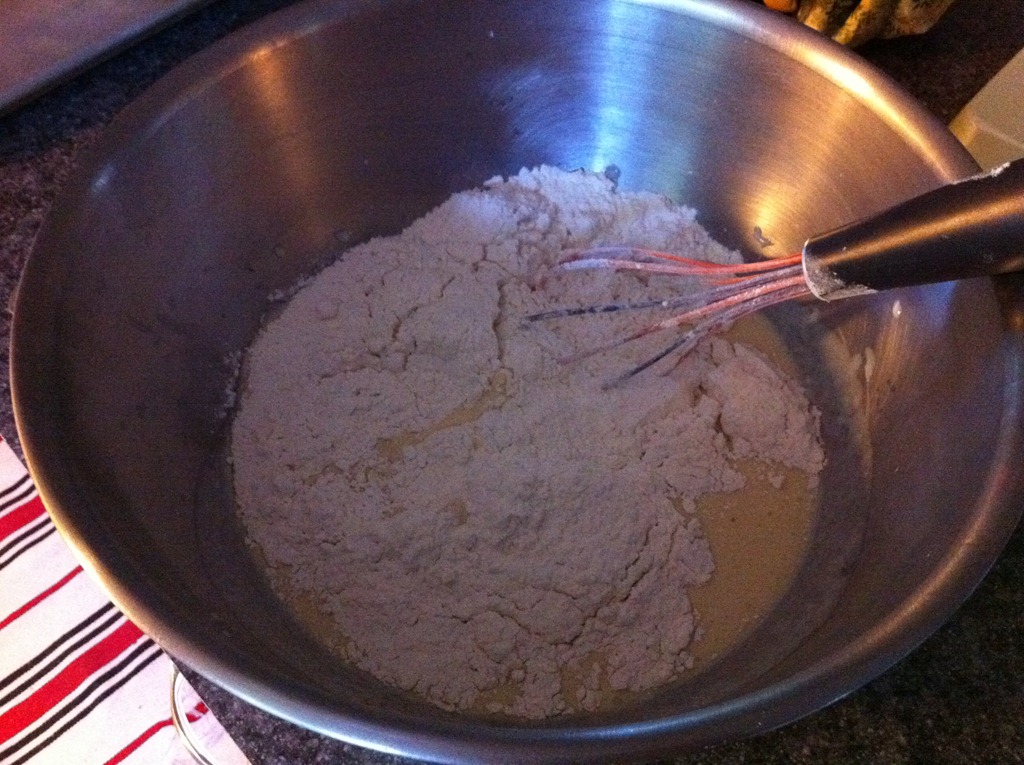
  • [I dump the flour in on top of the wet ingredients, then add the rest of the dry ingredients and mix slowly ’til it’s all a little lumpy]
  • chocolate chips (opt. — don’t mix them into the batter, that’s yucky)

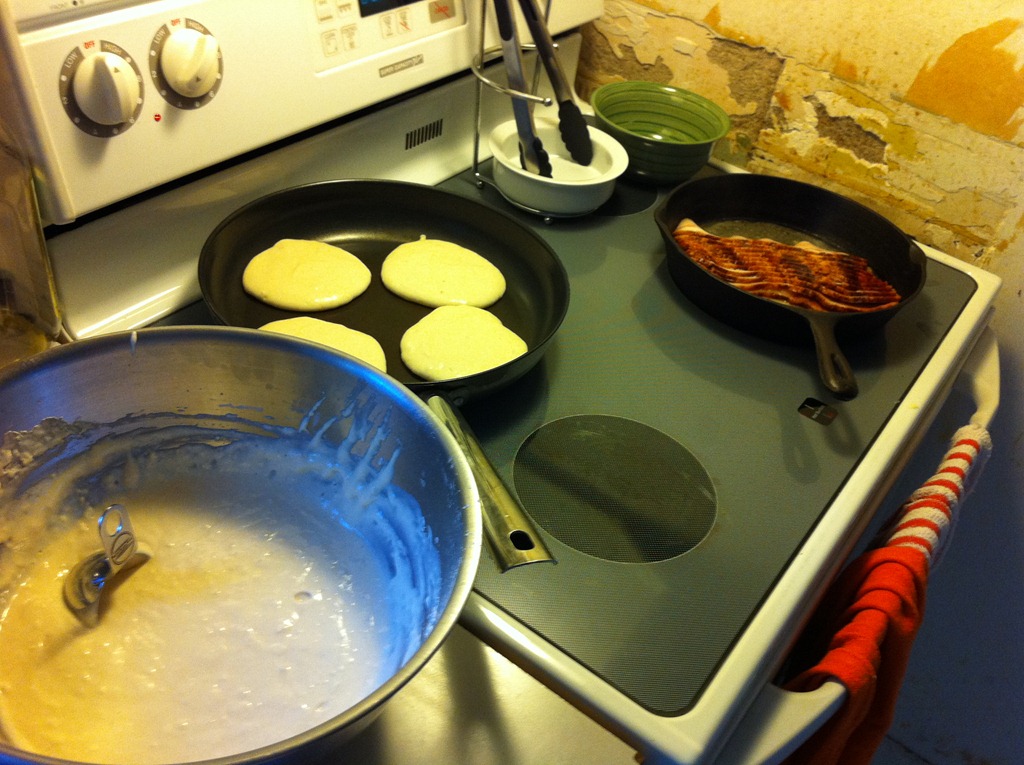
All the while, before cooking them, I have the pan set on medium-low heat (4 out of 10 on our stove top). It’s important the skillet be neither too hot nor too cool. Too hot and you get burned pancakes, too cool and you get limp, lame ones.  Here are some photos I took this morning as I went along.

The wet stuff, sugar not pictured.

IMG_1025

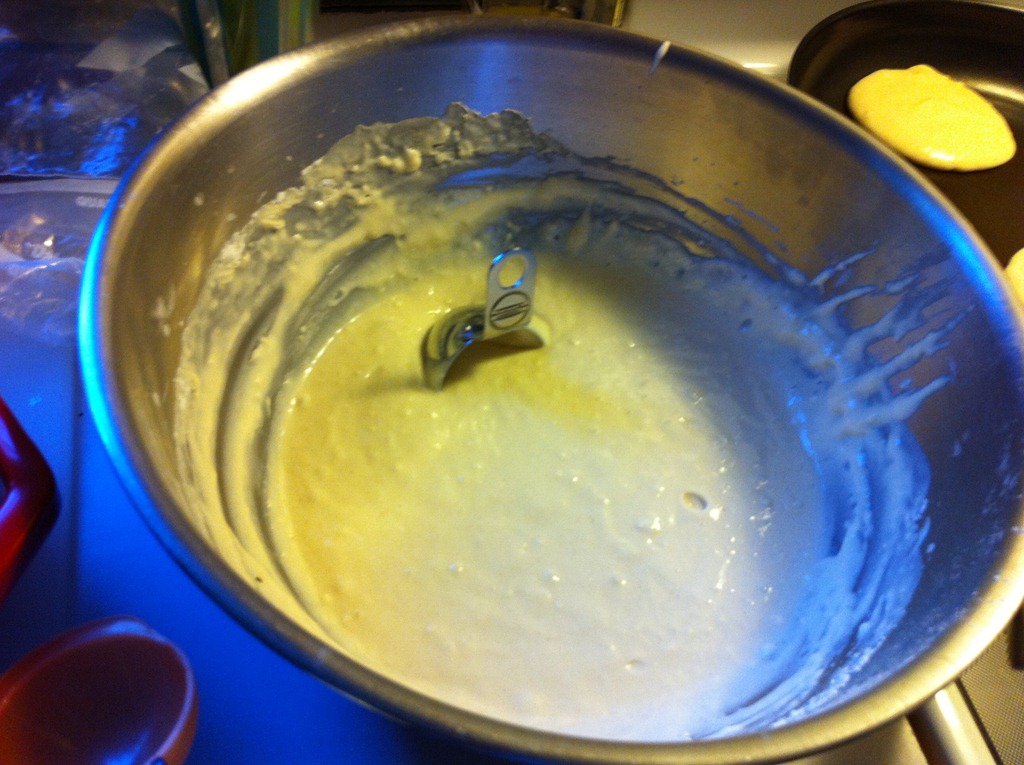
As mentioned, I put the flour right in w/the first set of stuff, then mix slowly until it looks a “little” lumpy. You don’t want pancake batter to be too smooth, some lumps are good.

IMG_1024

Could probably even be lumpier than this…

IMG_1027

First group is always w/out choc. chips for testing purposes. Flipped gold.

IMG_1028 IMG_1031

Chocolate chips for the wife and boy. I prefer them without (crazy)!

IMG_1032

Tasty pig optional (well, maybe for you, not for us).

IMG_1033

Happy Eaters are a requirement! Silly ones, too.

IMG_1035 IMG_1036

Giant pancake to finish off the batter: optional but fun.

IMG_1034